Wireless Cat Fence Solutions
Even the coziest of lap cats may consider escaping into the outside world at times. If you have determined that it is safe, letting your cat venture out into your yard to explore is a wonderful gift to give them. However, you may wonder how you can keep them from wandering off your property. Pet Stop® offers cat fences that work on the same concept as our dog fences.
How Our Cat Fences Work
Pet Stop® offers cat fences that can be used both indoors and outdoors. Made in the USA, our cat fences consist of boundary wire, a receiver collar and a transmitter. Choose from three of our systems: The EcoLite, UltraElite and the Consumer’s Digest Best Buy award-winning PC-200.
Here’s how it works: You install the underground boundary wire, then place your transmitter somewhere safe, like your basement or garage. When your cat approaches the boundary wire, it will be alerted; if it attempts to cross the boundary wire, the receiver collar will emit a light sensation, something like a tickle, to move your cat away from the boundary.
All three systems have collar receivers that feature TriScann®, Flash Alert® and Safety Stop®. You will know if the battery is running low, and your cat will be safe if they are somehow stranded in the boundary field. The transmitters all feature Power Loss Memory, a Wire Break Indicator, Lightning Protection, and Zapp Alert®. You will immediately become aware if any element isn’t working as it should.
Have questions about fences for cats? Contact one of our experienced and educated Pros at Pet Stop® today.
Advantages Of Wireless Cat Fences
Cats are escape artists; they jump high, squeeze through tight spaces, and have a seemingly unlimited appetite for mischief. Cat owners know that if their cats can find a way to get into something they’re not supposed to, they will.
This means that it’s almost impossible to build a cat-proof fence unless you’re fully enclosing an area, and that might make it difficult for your cat to engage in their natural curiosity and need to roam their territory. An effective cat fence that doesn’t fence your cat in completely? It’s possible with our wireless cat fences. Here are a few of the advantages:
- They’re far more affordable than traditional fences.
- Your cat can be trained on your wireless cat fence in no time flat.
- It’s a truly cat-proof fence.
- Our fences work for outdoor cats/indoor cats.
- With the Room Wizard™ indoor transmitter, you can even set boundaries in your home.
Other Types of Cat Fences
Let’s face it, there are only a couple ways that are really going to solve your problem. Many people resort to using DIY cat fence solutions but when that’s no longer working, what do you do then? Let’s take a look at a few of the pros and cons of traditional fences out there used to control our feline companions. It is a wonderful time to be a proud cat owner. New cat fence options are reaching the market every day, for all types of households, budgets, and cat temperaments. Listed below are the four most widely-available cat fences: what they are, how they work, and how effective they are.
Cat Fence Rollers
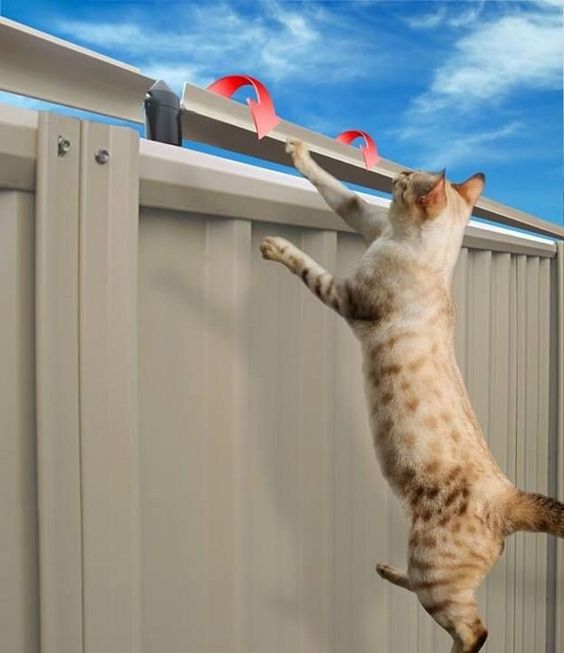
As you can see from the diagram, this tech works by simply rolling as your feline friend reaches the top of the barricade. In doing so, the roller rotates and prevents paws from gripping. These types of rollers will also prevent unwanted cats from reaching inside your premises as well.
Naturally, cats want to stray. It’s in their nature to explore the outdoors & observe their surroundings on a daily basis.
Unfortunately, with these systems, there’s lack of capability depending on what type of perimeter you have set in your background or front yard. An underground fence or wireless fence would prove to a more effective system as it allows you to have the desired fence you’d like without compromising the aesthetics.
Not a fan of the high-tech escape-proofing? Check out a time-tested solution: cat fence rollers.
Why cat fence rollers?
Cat fence rollers are a harmless way to keep your cat within the confines of your backyard.
Where can I place cat fence rollers?
Cat rollers are placed atop your existing fence, in order to prevent your cat from escaping your yard.
What are cat rollers?
Cat rollers are simply wooden or metal bars or rails that roll, so cats are unable to get the proper footing to escape.
How do cat fence rollers work?
Placed at the highest level on your gate or fence, cat fence rollers are an effective, very humane way to keep your cat safe in her yard. The agilest feline will never escape the slippery rails of a roller.
Are cat fence rollers effective?
Cat fence rollers are still in wide use today, throughout the world. Aesthetically, they blend in with the look of a home and are unobtrusive. They are easy to maintain and are ideal for cat owners who prefer a traditional approach to cat containment.
The Wireless Cat Fence Option
Want to keep your cat safely contained out in the yard, or safely off your kitchen counters? Consider a wireless cat fence! Here are the basics:
Why a wireless cat fence?
A wireless cat fence is the most discreet way to establish boundaries in and outside of your (cat’s)home. It is also one of the easiest barrier systems to set up, and they are available in all price points, sizes and programmable options.
Where can I place a wireless cat fence?
Wireless cat fences can be used outside, in your back or front yard, or inside, keeping your cat safely out of innocent mischief, inappropriate scratching, clawing and spraying areas, and even harm’s way.
What makes up a wireless cat fence?
Wireless cat fences consist of just two components: a signal transmitter and a receiver collar. Initially, you may want to use boundary flags when you begin perimeter training, but they are removed once your cat recognizes and respects her new limits.
The collars typically weigh one ounce or less. You want them to fit comfortably, yet snug, keeping one finger width between the collar and your pet. This will help enhance the effectiveness of the system. If you are using the wireless fence as an outdoor containment system, feel free to remove the collar while your cat is inside, to prevent any potential collar irritation.
The signal transmitter comes in a variety of sizes, shapes, and types. Most are typically the size of a smoke alarm, although some indoor systems may be a small, coaster-sized disk. Outdoor wireless fences have transmitters that are weather- and lightning-proof and can be placed in a garage or basement. If you are concerned about aesthetics, rock-shaped transmitters, easily camouflaged in your landscaping, are also available.
The type of transmitter varies, with some using sound, others static sensations, and others, both, to curtail your cat’s escape. More info on how they work is below.
How does a wireless cat fence work?
You will place the transmitter where you want the boundary to be, either indoors or outside. You can designate a small area (maybe just around your front door) or your entire back or front yard. The transmitter will emit a radio signal in all directions. When your cat gets too close to the boundary, a small alarm will sound on the receiver collar, alerting her to back away.
Unlike dog fences, which sometimes have trouble deterring certain hunting breeds, cat fences require very low-level preventative measures to corral your feline friend. For sonic transmitters, an alarm sounds when your cat enters the designated no-go zone. It isn’t loud, just enough to alert and remind the cat to remain within the barriers of the wireless fence.
The sensation transmitted in the other systems is a very subtle, almost imperceptible tickle to remind Fluffy to stay inside her perimeter. It takes very little to deter the cats, and they quickly learn to adapt to this new, safer environment.
Are wireless fences effective?
If we are judging effectiveness based on the volume of sales and number of new products hitting the market, then yes, wireless fences could be considered VERY effective at keeping your cat safe. The number of programmable options for each system is reassurance that you will find the safest and best deterrent to keep your cat out of harm’s way.

Underground Cat Fences
Underground, or “in-ground” cat fences, are similar to the wireless system in many ways but have a few small differences.
Why an underground cat fence?
Unlike wireless fences, the underground fence can cover a much larger area and can be customized to your particular needs. Need an even larger area of coverage? Just purchase more wire to extend the perimeter.
Underground cat fences are called this because their system contains one more component than the wireless cat fence system: a thin, flexible wire that you bury in the ground in your designated boundary.
Where can I place an underground cat fence?
Don’t get hung up on the “underground” description; if using inside, the boundary wire can be easily bundled with existing household wires, and remain discreet.
If using outside, the possibilities are endless. You can designate a boundary to keep your precious cat out of a pool area, landscaping, a children’s area, or a garden.
How does an underground cat fence work?
Underground cat fences work in exactly the same way as their wireless counterparts: sending a sound or sensation to the receiver collar when the designated barrier is breached. Only instead of a radio signal, you have a physical wire present.
Are underground cat fences effective?
Sold alongside the wireless cat fence options, these systems are neck-and-neck sales-wise with their wireless cousins. Newer, sleeker, more programmable versions are hitting the market every few months.
Cat Fence Spikes
Why cat fence spikes?
Inexpensive and effective, cat fence spikes can be the perfect solution when you have few options.
Where can I place cat fence spikes?
Cat fence spike strips can be placed anywhere you desire to keep your pet contained. Typically, they are placed on top of fences and gates.
What are cat fence spikes?
The spikes are usually made of rubber, as cat paws are very sensitive and need little discomfort to deter them. You buy them by the strip and can customize their length and width.
How do cat fence spikes work?
Spikes provide just enough discomfort to discourage your cat from climbing over a fence. Cats learn quickly which areas to avoid.
Are cat fence spikes effective?
The reviews are mixed. Cat owners claim that the spikes sometimes are not enough of a deterrent to their pet. Other owners balk at the appearance of the spikes on their fences.
No matter which system you choose, you are making the right choice when you make your cat’s home a safe and happy one! Best of luck and happy shopping!
Our Wireless Cat Fence Features
Pet Stop® products have some of the most advanced features on the market:
- They have low battery alerts, so your cat’s collar will never stop working when it matters most.
- Broken wire indicators give you the chance to find out your fence is no longer operational—before your cat does.
- Programmable collars accommodate your cat’s breed and temperament. Pet Stop® works for cats of all sizes.
- Power Loss Memory (PLM) remembers all your settings in case of a power outage.
- Lightning Protection and Zapp AlertⓇ, Pet Stop’s exclusive alarm, alerts you to a surge in the system and possible impairment.
- StabiliTemp protects your transmitter from temperature extremes that can occur in garages and basements.
- The Room Wizard™ indoor transmitter allows you to set boundaries indoors, which can stop your indoor cat from becoming an outdoor cat.
Wireless Fences Vs. Traditional Fences
The biggest problem with a DIY cat fence kit is that it may not be effective at doing the one thing it’s supposed to do: Creating a safe outdoor space for your cat. Agile cats may be able to jump over or crawl under the fence. A complete cat enclosure—one where your cat cannot escape—can create other problems. Stray cats and other animals may approach and harass your cat, which cannot engage its natural defences. Your cat may also feel trapped by the enclosed space, unable to roam as freely as it wants.
That’s just DIY cat fence kits; full, traditional fences are even worse. They’re extremely costly, you need to acquire permits, and you might have to have long, difficult conversations with your neighbors about installation. Worst of all, they’re not effective; how many cats have you seen hanging out on fence posts as you walk through your neighborhood? There’s a reason you see them so frequently; traditional fences are not effective at keeping cats safe.
Our wireless fences ensure your cat’s safety without making them feel trapped, all at a fraction of the cost of an ineffective traditional fencing system.
The GentleSteps Training Program
We are proud to offer GentleSteps™ training for your cat to get used to their new limits. As the cat approaches the fence’s perimeter, they’ll feel a very light tickle for a millisecond. It helps them to learn where they can roam and where they need to stop.
Your cat can also learn their boundaries inside the home. You just need our Room Wizard™ indoor transmitter, which is compatible with the outdoor transmitter. Available in wired or battery-operated versions, it is stylish and discreet. Use it to keep your cat out of whatever room you choose.
Installation
Installing our cat fences is simple; all you have to do is contact your local Pet Stop® dealer! They will work with you to find the perfect configuration for your cat fence. Once you’ve found the right configuration for your needs, they will bury the boundary wire, install the signal transmitter, and customize your cat’s receiver collar with the perfect settings.
Your Pet Stop dealer will also provide a training session to ensure that your underground fence is working properly; during this session, they’ll also give you tips to ensure that you and your cat get the most out of your new invisible fence!
Common Layouts
Choosing the right layout will give your cat access to the areas where you want them to roam, all while keeping them away from dangerous or sensitive spaces. Here are a few of the most common layouts for our cat fences:
- Simple loop
- Double loop
- Simple loop with exclusion areas
- Backyard and front yard loop
By choosing the right layout, you can set the perfect boundaries for your cat! We can also help you configure indoor boundaries to keep your cat safe.
Our Other Services:
 Pet Stop
 Get a Free Quote
Connect with Your Local Pet Safety Experts at Pet Stop. Visit, call, or
chat with us – we’re here to help you create the ultimate safe haven for your pet.
Get a Free quote
Name *
Zip code where new fence is required *
What breed is your dog?
Phone Number to Call/Text *
Email (optional)
Address *
Stay Connected, Stay in Control
Brief introduction to the OT-300, highlighting remote control, real-time notifications, and easy setup through the Pet Stop Link App.
Download the App